

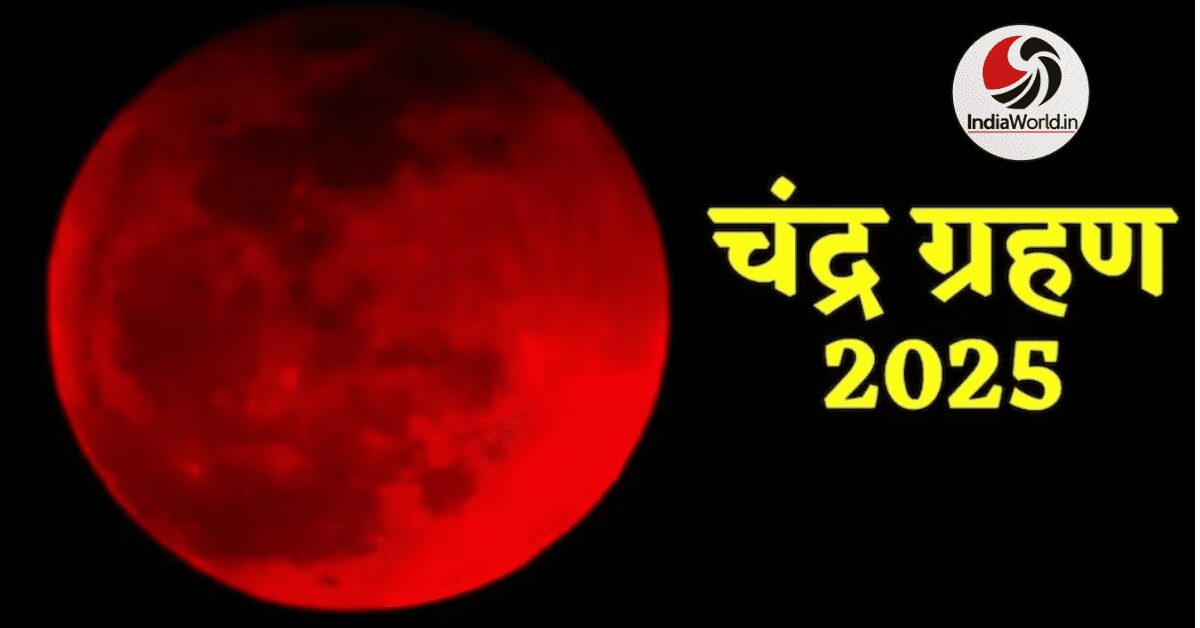
Get ready for a celestial spectacle! On Sunday, 7 September 2025, India will witness the second and final total lunar eclipse of the year—popularly known as Chandra Grahan or the Blood Moon. This rare event will be visible across the country and offers a stunning visual treat as the Moon turns a deep red hue while passing through Earth’s shadow.
Key Timings of Chandra Grahan 2025 (IST)
| Eclipse Phase | Time (IST) |
|---|---|
| Penumbral Eclipse Begins | 8:59 PM (7 Sept) |
| Partial Eclipse Begins | 9:58 PM |
| Total Eclipse Begins | 11:01 PM |
| Greatest Eclipse | 11:42 PM |
| Total Eclipse Ends | 12:22 AM (8 Sept) |
| Partial Eclipse Ends | 1:26 AM |
| Penumbral Eclipse Ends | 2:24 AM |
🕒 Totality Duration: 1 hour, 21 minutes
🌘 Entire Eclipse Duration: Over 5 hours
Where Will It Be Visible?
The Chandra Grahan 2025 will be clearly visible across all parts of India, including:

- North India: Delhi, Chandigarh, Jaipur, Lucknow
- South India: Chennai, Bengaluru, Hyderabad, Kochi
- East India: Kolkata, Bhubaneswar, Guwahati
- West India: Mumbai, Ahmedabad, Pune
- Central India: Bhopal, Nagpur, Raipur
Other regions with full visibility include Asia, Eastern Africa, Australia, and parts of Europe. However, North and South America will miss this eclipse entirely.
What Is a Blood Moon?
A Blood Moon occurs during a total lunar eclipse, when the Earth comes directly between the Sun and the Moon. Sunlight refracts through Earth’s atmosphere, scattering blue light and allowing only red tones to reach the Moon—giving it a coppery-red glow that captivates skywatchers worldwide.
Spiritual & Cultural Significance
This Chandra Grahan coincides with Bhadrapada Shukla Purnima and marks the beginning of Pitru Paksha, a sacred period for honoring ancestors. Many families perform Shradh rituals and Tarpan during this time.

🕉️ Sutak Kaal (Inauspicious Period)
- Starts: 12:57 PM (7 Sept)
- Ends: 1:27 AM (8 Sept)
During Sutak, traditional practices advise avoiding cooking, eating, or performing pujas. Temples remain closed until the eclipse ends.
How to Watch & Capture the Eclipse
- Safe to view with naked eye—no filters or glasses needed
- Use binoculars or telescopes for detailed views
- For photography:
- Use tripod for stability
- Enable night mode or long exposure
- Set ISO to 400–800 and shutter speed to 1–2 seconds
- Try time-lapse mode for full transition
Why This Eclipse Is Special
- One of the longest total lunar eclipses of the decade
- Visible to over 85% of the global population
- Coincides with spiritually significant dates
- Offers a rare chance to connect science with tradition
Read also : Unique customs during Onam festival